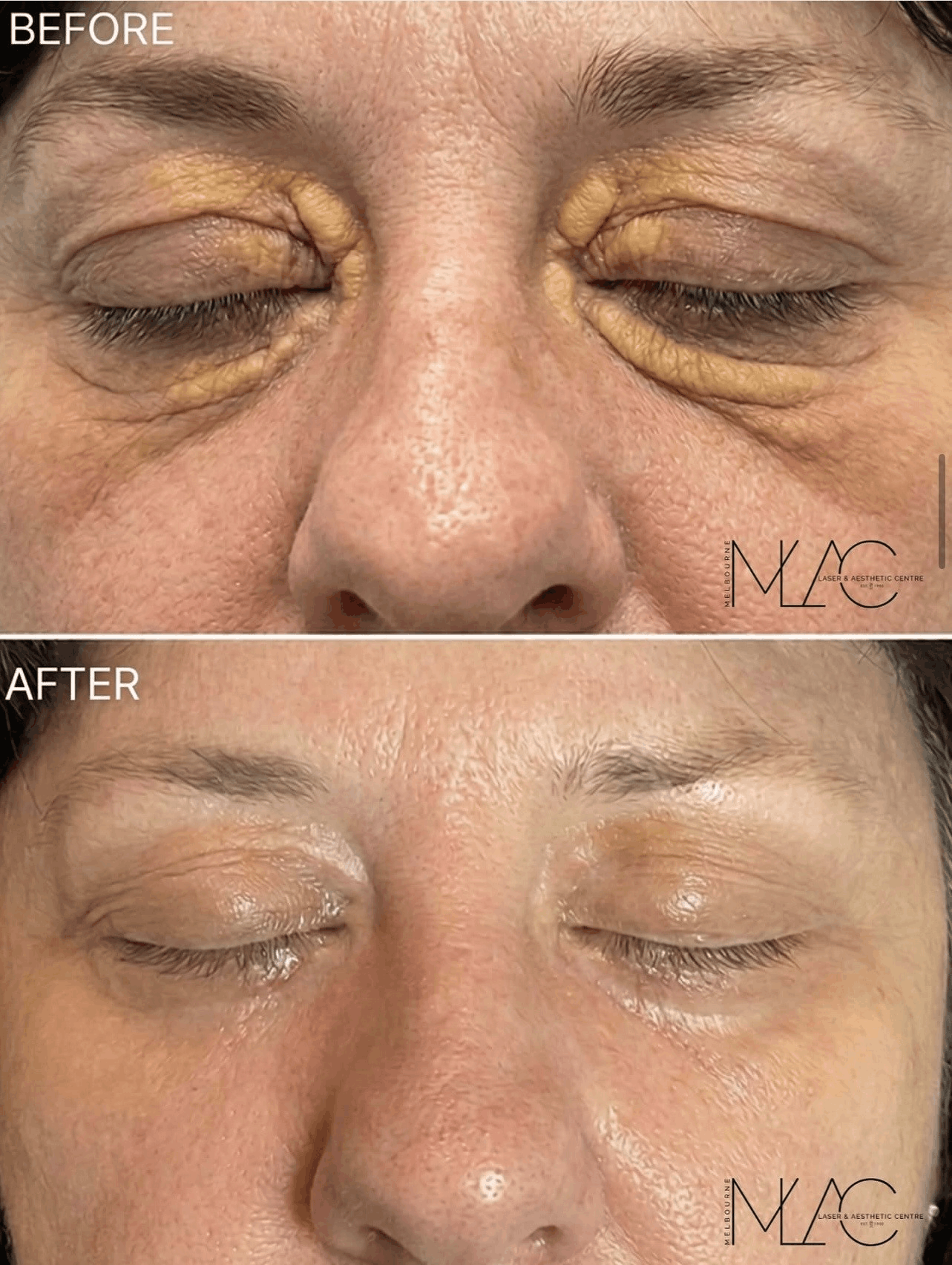
Xanthelasma are yellow or cream-coloured deposits that commonly develop around the upper and lower eyelids. Although usually benign, they can gradually become larger and more noticeable.
The case pictured demonstrates extensive xanthelasma affecting both the upper and lower eyelids and the significant improvement achieved following treatment at MLAC. It also highlights why our approach goes beyond simply removing the visible deposits. We consider the xanthelasma itself, the delicate surrounding eyelid skin and the overall aesthetic outcome.
At Melbourne Laser & Aesthetic Centre (MLAC), our approach goes beyond simply removing the visible xanthelasma. We consider the lesion itself, the delicate surrounding eyelid skin and the overall aesthetic outcome.
Xanthelasma palpebrarum consists of cholesterol-rich deposits within the skin around the eyes. While xanthelasma can be associated with elevated cholesterol or other lipid abnormalities, it can also occur in people with normal cholesterol levels.
Relevant medical history and underlying factors are therefore considered as part of consultation and treatment planning.
CO₂ laser is an established treatment option for xanthelasma, allowing controlled and precise treatment of the deposits.
Research supports its effectiveness. A systematic review involving 49 studies and 1,329 patients found CO₂ to be one of the most extensively studied laser treatments for xanthelasma.
A more recent study involving 295 patients reported greater than 95% clearance, although thicker lesions were more likely to require additional treatments and experience recurrence.
View the systematic review on PubMed
View the 295-patient CO₂ study on PubMed
There are several approaches to xanthelasma removal. The most appropriate treatment depends on the size, depth, thickness, location and individual characteristics of the deposits.
Trichloroacetic acid (TCA) is a chemical treatment that can be effective, particularly for smaller and more superficial xanthelasma.
One of its limitations is that the depth of chemical penetration is less precisely controlled than laser ablation. This is an important consideration when working with delicate eyelid skin.
Published literature reports potential complications including hyperpigmentation, hypopigmentation, irritation and scarring, and repeated treatments may be required.
Surgical excision can provide effective clearance and remains an important treatment option, particularly for large or deeply infiltrating xanthelasma.
However, surgery is more invasive. Depending on the extent and location of the deposits, treatment may require incisions, sutures and sometimes more complex reconstructive techniques.
Potential disadvantages can include scarring, pigmentary changes and changes to eyelid contour or position. Importantly, xanthelasma can still recur following surgical removal.
Therefore, surgery may be appropriate for some patients, but it is not necessarily required for every xanthelasma.
For appropriately selected cases, MLAC may incorporate precise CO₂ ablation together with mixed fractional CO₂ and 1540nm technology.
CO₂ allows controlled ablation of the xanthelasma itself without surgically excising and suturing the eyelid skin.
Where appropriate, fractional CO₂ and non-ablative 1540nm technology can then be incorporated to support collagen remodelling, skin texture and refinement of the surrounding periorbital skin.
This is particularly valuable when xanthelasma is more extensive or involves multiple areas of the upper and lower eyelids.
Our objective is not simply to remove the xanthelasma, but to consider how the entire area will look once it has healed.
Our recent @melbournelaser before-and-after case demonstrates treatment of extensive xanthelasma involving both the upper and lower eyelids.
The after image shows the appearance following the patient’s individual treatment program, with substantial reduction of the visible xanthelasma together with refinement of the surrounding eye area.
Individual results vary, and treatment depends on the size, thickness, depth and distribution of the xanthelasma.
Want to see more real treatment results? Follow @melbournelaser for before-and-after cases, treatment insights and the latest laser and skin treatments from MLAC.
Follow @melbournelaser on Instagram
Following successful clearance, xanthelasma does not typically suddenly “come back.” Recurrence is generally a slow accumulation of new cholesterol deposits within the skin over time.
A recent study of 295 patients treated with CO₂ laser reported a low 6.8% recurrence rate at 12 months. View the study on PubMed.
This is consistent with our experience at MLAC, where clearance is generally maintained for extended periods. If new deposits develop, they are often small and gradual, sometimes two years or more later, when a minor laser touch-up may be sufficient.
Following surgical removal, any new deposits may develop around an existing linear scar, making further aesthetic refinement more challenging. In suitable cases, laser treatment may provide a less invasive option than repeat surgery while also allowing refinement of the surrounding skin.
There is no single treatment number that applies to everyone.
Smaller and more superficial xanthelasma may require fewer treatments, while thicker or more extensive deposits may require a staged approach.
A consultation allows us to assess the size, thickness, depth and location of the xanthelasma and determine the most appropriate treatment approach.
Melbourne Laser & Aesthetic Centre has been established in Melbourne since 1990, with over 35 years of experience in laser and aesthetic skin treatments.
Our qualified clinicians assess the xanthelasma, surrounding eyelid skin and relevant medical history before determining suitability and developing an individualised treatment plan.
Depending on the presentation, treatment may involve precise CO₂ ablation or a combination approach incorporating mixed fractional CO₂ and 1540nm technology.
A consultation is the first step. We can assess your xanthelasma and discuss the most appropriate treatment approach for your individual presentation.
For more real treatment results, before-and-after cases and educational content, follow Melbourne Laser & Aesthetic Centre on Instagram.
Follow @melbournelaser on Instagram
.


